Sukuk yield and the stated profit rate answer different questions. A profit or periodic distribution rate describes a contractual calculation. A quoted yield also depends on the price you pay and the cash flows assumed. Neither number, by itself, proves that an investment is suitable, safe or Shariah-compliant.
This educational guide helps English-speaking Muslim investors read a quotation more carefully. It is not a recommendation to buy a security, a personalized financial opinion or a Shariah ruling. The examples are hypothetical and deliberately simplified. An actual certificate’s offering documents, legal structure, payment schedule and applicable scholarly review control its interpretation.
What does sukuk yield measure?
Begin by asking which yield is displayed. A running yield looks at annual distributions relative to price. A yield to maturity estimates an annualized rate from the purchase price and assumed remaining payments through a specified maturity. A yield to call instead uses a particular early-redemption scenario. These measures are not interchangeable.
The SEC’s current-yield definition explains the general income-to-market-price calculation. Its examples concern conventional securities; using the arithmetic here does not equate their contracts with sukuk or provide a religious endorsement.
| Term on a quotation | Question it answers | What to verify |
|---|---|---|
| Profit or distribution rate | How is the periodic amount calculated? | Fixed or variable formula, calculation amount and payment dates |
| Running yield | How much annual distribution is shown relative to price? | Denominator, annualization and exclusions |
| Yield to maturity | What annualized cash-flow rate is implied to maturity? | Price, settlement, redemption and payment assumptions |
| Yield to call | What rate is implied if a specified call occurs? | Call date, call price and whether redemption is optional |
| Realized return | What did the investor actually gain or lose? | Actual receipts, sale proceeds, fees, tax and currency conversion |
Sukuk yield example: the same distribution at three prices
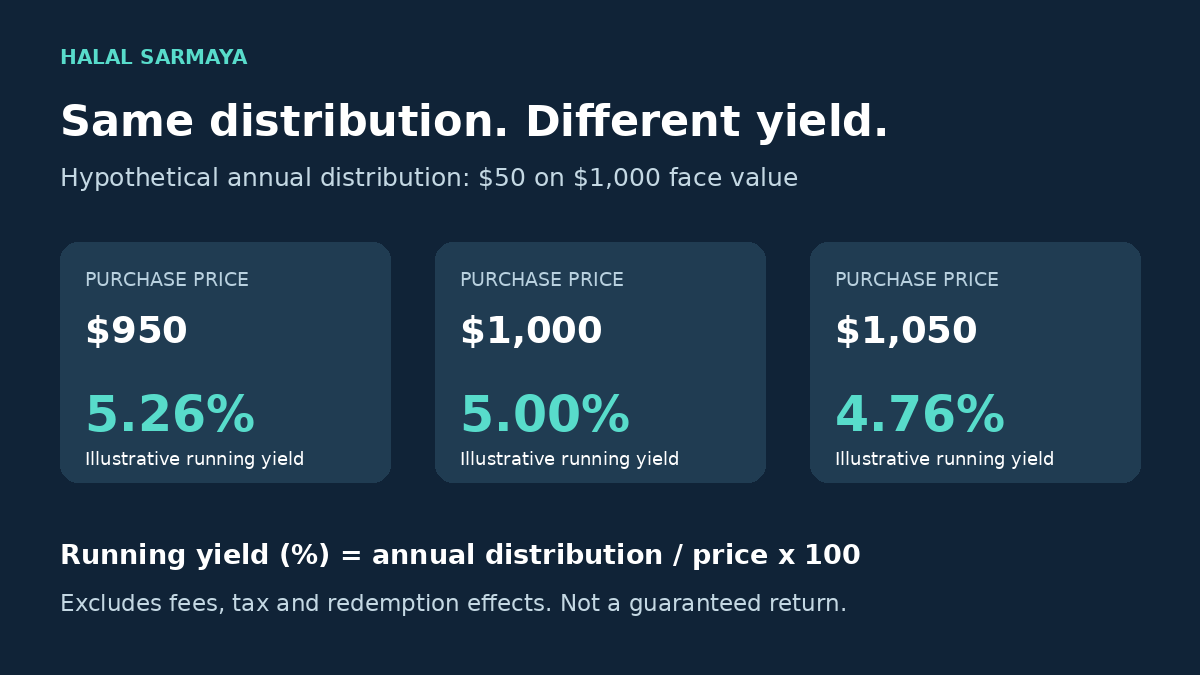
Assume a fictional certificate with a calculation amount of $1,000 and an annual distribution of $50. For illustration only, the stated distribution rate is therefore 5%. Ignore settlement accruals, fees, taxes, currency movements and payment timing. Assume the annual amount remains unchanged and is paid in full.
| Purchase price | Annual distribution | Calculation | Running yield |
|---|---|---|---|
| $950 | $50 | 50 ÷ 950 × 100 | 5.26% |
| $1,000 | $50 | 50 ÷ 1,000 × 100 | 5.00% |
| $1,050 | $50 | 50 ÷ 1,050 × 100 | 4.76% |
The stated 5% rate did not change. The income relative to the purchase price changed. This is arithmetic based on an assumed fixed payment, not evidence that the lower-priced certificate is the better investment. A lower price might reflect concerns that the assumed payment will not arrive.
Now assume, separately, that the fictional certificate is redeemed for $1,000 at its scheduled end. Paying $1,050 creates a $50 difference between purchase price and that redemption amount. Receiving distributions does not erase the need to include this difference. Paying $950 creates the opposite price difference, but only if the assumed redemption actually occurs. A running-yield figure leaves both effects out.
To calculate a maturity yield accurately, use the actual payment dates, settlement convention and redemption terms. This article intentionally does not label the running-yield percentages as maturity yields. Ask the broker to explain its calculation rather than accepting an unlabeled percentage.
5 essential sukuk yield checks before comparing offers
1. Identify the exact certificate and cash-flow terms
Record the issuer or special-purpose vehicle, obligor where applicable, identifier, currency, maturity and governing documents. Read how distributions and redemption amounts are defined. A marketing name does not establish enforceable rights or the assets available after default.
For a broader due-diligence habit, our guide to reading an offering before investing emphasizes documenting the business and financial information rather than trusting a label. Its equity-specific screening tests should not be transplanted into sukuk analysis.
2. Ask which price the quoted yield uses
Write down whether the quote is indicative or executable and the time it was supplied. Ask whether it uses a buying price, selling price or another reference. Obtain the total settlement amount and a breakdown of any accrued distribution, dealing charge and custody fee that applies.
As an original arithmetic example, a $50 annual distribution divided by a $950 price gives 5.26%. If a hypothetical $10 purchase fee makes the initial outlay $960, $50 divided by that outlay is 5.21%. This simple cash-outlay ratio is not a standardized yield quotation or a complete return calculation; it just shows why omitted costs matter.
3. Separate maturity from an optional call
A displayed redemption scenario may not be the only possible outcome. Ask which party can exercise an early call, under what conditions and at what amount. If there is an extension feature or no conventional fixed maturity, request an explanation of the yield convention used.
The SEC’s corporate-bond investor bulletin explains general maturity, call and credit-risk concepts. Those concepts help frame questions, but a sukuk’s own legal documents determine its terms. Do not treat a hypothetical call date as a promise that money will be returned then.
4. Compare risk before ranking percentages
Record credit quality, maturity, liquidity, currency and legal recourse beside the yield. A higher quoted percentage should prompt investigation of the assumptions and risks. Do not rank two instruments solely by whichever number is larger.
BIX Malaysia’s investor education on risk and return describes the relationship between market price, yield and credit risk. For a fixed assumed payment stream, a lower price implies a higher calculated yield; it does not make the underlying payments more certain.
If you may need to sell early, request information about actual dealing availability and the difference between buy and sell quotations. A mathematical maturity yield does not describe the price another buyer will offer on your chosen exit date.
5. Keep the Shariah review separate from the return calculation
Request the relevant Shariah documentation, the structure description and the basis on which the instrument is approved for the intended transaction. Bring unresolved questions about ownership, cash flows, trading and contractual undertakings to a qualified adviser familiar with the documents and applicable jurisdiction.
A numerical yield cannot establish a religious ruling. Similarly, the presence of a scholarly approval does not guarantee payment, liquidity or investment performance. Our explanation of why screening methodologies can differ illustrates the importance of identifying the method being applied, while remaining an equity-focused guide rather than a sukuk approval checklist.
A practical sukuk yield comparison worksheet
Make one row per certificate and attach the dated quotation and source document. The following is a research worksheet, not a ranking model. A blank answer is an unresolved question, not a zero-risk score.
- Identity: identifier, issuer, obligor, currency and minimum trade size.
- Cash flows: calculation amount, distribution formula, payment frequency and redemption terms.
- Quote: date, time, price type, yield label, settlement amount and charges.
- Scenarios: scheduled maturity, optional call, early sale and missed payment.
- Rights: recourse, governing law, ranking and enforcement information.
- Review: Shariah documentation, qualified review questions and unresolved limitations.
Before making a comparison, explain the quoted sukuk yield in a single sentence: “This figure uses this purchase price and assumes these payments until this date.” If the seller cannot clarify those inputs, the comparison is incomplete.
Frequently asked questions about sukuk yield
Is a 5% profit rate the same as a 5% return?
Not necessarily. The rate may apply to a contractual calculation amount, while your actual outlay differs. Costs, payment timing, redemption, sale price, defaults and currency movements can affect your result.
Does a higher sukuk yield mean a better investment?
No. It can reflect a lower market price or different assumptions and risks. Compare the instrument’s documented rights, cash flows and risks before drawing a conclusion.
Can a distribution be fixed while the market price changes?
In the fixed-payment illustration above, yes: the assumed annual payment stays at $50 while the purchase price changes. Actual distribution formulas and payment obligations must be checked in the specific offering documents.
Does this calculation decide whether sukuk are halal?
No. Financial arithmetic and Shariah assessment are separate tasks. Seek qualified interpretation of the actual structure; this guide does not issue a universal ruling.
Next step: Ask for a dated quotation, the exact yield definition and the offering documents. Use the worksheet to record uncertainties before considering any transaction.
Prepared for Halal Sarmaya. Educational documentation review and original hypothetical calculations; no live prices, guaranteed returns or personal investment experience claimed. Sources checked October 27, 2026.