Asset-based vs asset-backed sukuk is not just a terminology question. It can change what investors actually have a claim against if scheduled payments stop. A sukuk certificate may reference an asset, yet the investor’s effective recovery rights can depend heavily on contractual undertakings, transfer documentation, governing law and the financial condition of an obligor.
Quick answer: do not infer legal ownership, collateral or guaranteed recovery from the word sukuk, from an asset photograph, or from a marketing description. Read the actual offering circular, trust deed, purchase undertaking and risk factors. This guide explains what to look for; it does not certify any instrument as Shariah-compliant or recommend an investment.
Asset-Based vs Asset-Backed Sukuk: What Is the Difference?
Asset-based sukuk: the documents often create economic exposure associated with specified assets while the investor’s practical repayment depends substantially on promises or obligations of an originator or other obligor. A repurchase undertaking can be central. The Islamic Financial Services Board’s IFSB-7 discusses structures where the relevant credit risk is that of the originator, subject to any permissible enhancement. It also warns that legal obstacles may prevent investors from enforcing rights over underlying assets.
Asset-backed sukuk: an effective transfer of rights and a structure in which payments depend on assets and their cash flows may be more important. However, the phrase alone does not prove that investors can seize or sell the assets. The IFSB’s discussion of Islamic asset securitisation describes limited-recourse arrangements in which proceeds from underlying assets may be the sole source of payment and may fall short.
These are useful analytical categories, not a substitute for reading the governing documents. A structure can contain features of both, and legal enforceability varies by jurisdiction.
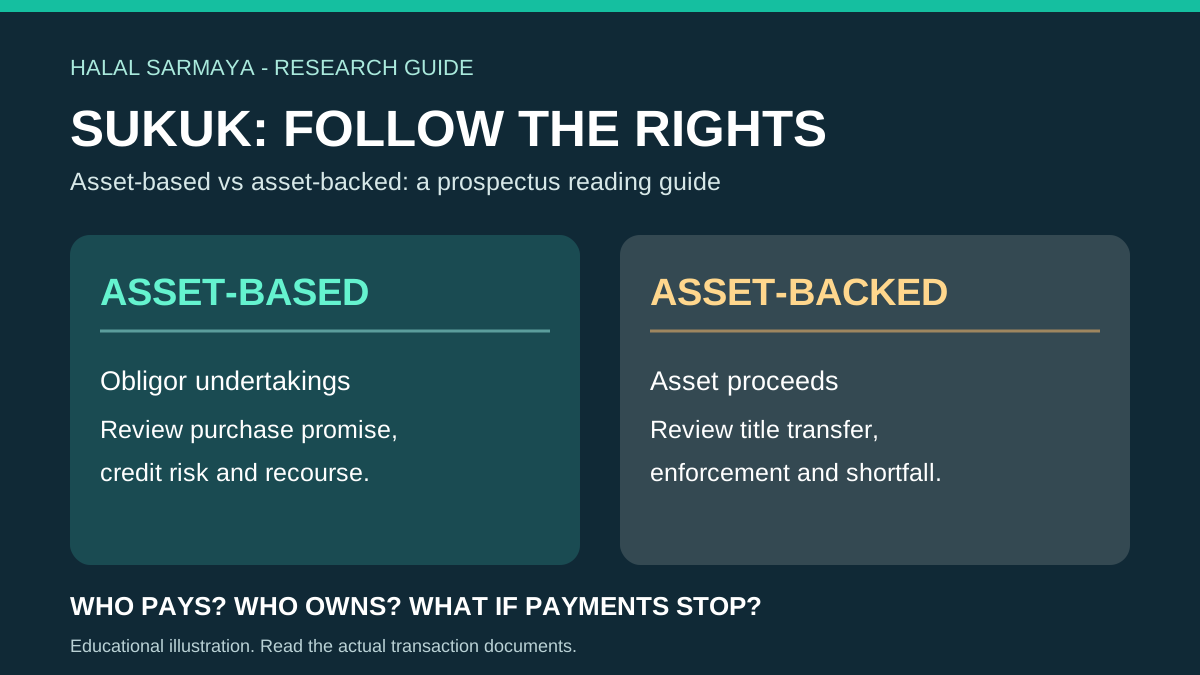
Comparison: what to verify in the documents
| Question | Often seen in asset-based structures | Often seen in asset-backed structures |
|---|---|---|
| Primary payment exposure | Obligor’s payment and purchase undertakings | Cash generated by specified assets or receivables |
| Asset transfer | Beneficial or contractual interest may not give enforceable possession | Transfer and isolation of assets are central; legal effectiveness still needs verification |
| Recourse after default | Often primarily to an obligor under contracts | May be limited to asset proceeds, with possible shortfall |
| Key credit question | Can the obligor meet its obligations? | What are the assets worth, and can rights be enforced? |
| Documents to inspect | Purchase undertaking, obligor covenants, risk factors | Asset sale, trust/security documents, servicing and enforcement terms |
| What cannot be assumed | That underlying assets secure investors | That principal or periodic payments are guaranteed |
Source context: the 2024 ICMA–Islamic Development Bank–LSEG guidance describes the widespread use of asset-based sukuk and notes that asset-backed issuance is comparatively rare. That guidance addresses sustainable sukuk; its structural discussion is relevant here but it is not a Shariah ruling on a particular certificate.
Nine questions to ask before treating a sukuk as an asset investment
- Who is the legal issuer? Identify the issuing vehicle, trustee, originator and any guarantor or obligor. A special-purpose vehicle may have few assets of its own.
- Which assets are named? Look for a precise schedule or defined asset pool. A generic description of property or infrastructure is insufficient.
- What rights actually transfer? Distinguish legal title, beneficial interests, lease rights and contractual claims. Ask whether the transfer is recognised under the relevant local law.
- Where do periodic payments come from? Read the cash-flow waterfall: lease rentals, business profits, receivables, purchase undertakings or other mechanisms.
- Who promises to buy the assets back? Find the exercise price, triggers, conditions and credit exposure associated with any purchase undertaking.
- What happens after missed payments? Find the dissolution events, trustee powers, enforcement mechanics, grace periods and governing law.
- Can investors enforce rights over the assets? Check whether title, security and bankruptcy-remoteness opinions exist; look for jurisdictional restrictions.
- What Shariah approval applies? Identify the named adviser or board, the scope of its opinion, the contractual structure reviewed and any continuing monitoring arrangements. An approval is not a guarantee of performance.
- What are the practical risks? Examine currency exposure, liquidity, credit concentration, valuation, tax treatment and resale restrictions, as well as risks specific to the assets.
For an additional regulatory perspective, the Securities Commission Malaysia’s Prospectus Guidelines (revised 30 September 2026) include requirements for corporate bonds and sukuk. Applicable disclosure rules depend on where an offer is made; do not treat one country’s rules as universally binding.
Asset-Based vs Asset-Backed Sukuk: Worked Risk Example
Illustrative assumptions, not a real issue: suppose an investor holds certificates with a face amount of $10,000 and a projected annual distribution of 4%, or $400. The documents refer to an income-producing building. These numbers describe a hypothetical scenario, not a quoted yield or a promised return.
Scenario A — obligor-centred exposure: rental payments support the structure, but the investor’s key contractual claim after a dissolution event is against an obligor under a purchase undertaking. If that obligor cannot pay, recovery depends on the enforceable obligations and insolvency process. The fact that a building appears in the documents does not necessarily let investors sell it to recover $10,000.
Scenario B — limited recourse to assets: the transaction documents instead provide effective rights to a pool of assets, and recoveries are limited to their realisable proceeds. Suppose, purely for illustration, enforcement and sale leave $6,000 available for a $10,000 face amount. The shortfall is $4,000 before any additional contractual priorities or expenses. The outcome would depend on the real transaction documents and local law; no recovery percentage can be assumed in advance.
Lesson: the same $10,000 face amount and projected $400 distribution tell you almost nothing about the legal source of repayment. Read the recourse clauses and cash-flow waterfall before comparing instruments.
Does one structure automatically meet Shariah requirements?
No single structural label settles that question. Scholars and Shariah supervisory bodies may evaluate the asset transfer, allocation of risk, purchase undertakings, underlying activities and contractual promises differently. A transaction may be marketed as Islamic yet still require careful review against the specific standard followed by the investor’s qualified adviser.
The Securities Commission Malaysia’s 29 June 2026 guidance announcement explains that its Maqasid-focused guidance asks advisers and issuers to consider use of proceeds, structuring, governance, disclosure and wider outcomes alongside existing Shariah requirements. This is an additional analytical lens, not an automatic approval or disapproval of an individual sukuk.
Regulatory and issuer documents also distinguish credit and legal risk from religious compliance. For example, an SEC-filed fund prospectus from March 2025 explains that some sukuk are unsecured and that recovery can depend on the credit of an obligor. That is a risk disclosure by a fund, not an independent ruling on the Shariah status of every sukuk.
For a broader introduction to how product claims should be assessed, see our halal investing beginner guide. If you hold securities through a broker, the account’s idle-cash arrangement is a separate question; see our brokerage cash sweep checklist.
Frequently asked questions
Are sukuk the same as conventional bonds?
No. Their stated contractual foundations differ. However, some sukuk may expose investors to obligor credit risk and cash-flow patterns that resemble conventional debt. Inspect the actual structure rather than assuming that every certificate has the same rights.
Does an asset-based sukuk mean investors own the property?
Not necessarily in a directly enforceable way. The legal transfer, trustee arrangements, local property law and contractual remedies matter.
Does asset-backed mean risk-free?
No. Asset values can decline, payments can be delayed, and legal enforcement can be costly. Limited recourse may mean a shortfall cannot be recovered elsewhere.
Can a green or sustainable sukuk still require Shariah review?
Yes. A sustainability label concerns a different set of disclosures and objectives. Read the Shariah documentation and the use-of-proceeds and reporting framework separately.
What should I ask a scholar or adviser?
Bring the offering circular, asset-transfer and purchase-undertaking documents, the Shariah approval, and your specific questions about ownership, risk allocation and recourse. A qualified scholar can address religious questions; a licensed adviser can address financial suitability.
Primary sources and editorial notes
- Islamic Financial Services Board — IFSB-7: Capital Adequacy Requirements for Sukuk Securitisations and Real Estate Investment (regulatory standard; structural and credit-risk discussion).
- IFSB — Strategies for the Development of Islamic Capital Markets: Infrastructures and Legal Aspects of Islamic Asset Securitisation (limited-recourse analysis).
- ICMA, Islamic Development Bank and LSEG — Guidance on Green, Social and Sustainability Sukuk, April 2024 (structure and sustainability-label context).
- Securities Commission Malaysia — Prospectus Guidelines, revised 30 September 2026 (jurisdiction-specific disclosure rules).
- Securities Commission Malaysia — Maqasid Guidance Note announcement, 29 June 2026 (scope of additional governance and disclosure considerations).
- US SEC EDGAR — SP Funds prospectus filing, March 2025 (fund issuer’s sukuk risk disclosures; not a universal Shariah ruling).
Editorial review: 24 October 2026. Author: Dr. Zahid Al Hakim (name supplied by the site owner; no professional or scholarly credentials are asserted). This article is independent educational material, not a fatwa, Shariah certification, personal financial advice or a recommendation to buy or sell. Standards, legal rights and product documents differ; confirm current primary documentation and obtain appropriately qualified advice.