Brokerage cash sweep and interest can change the Shariah questions behind a trading account. Can a Muslim investor leave money uninvested in a conventional brokerage account? The answer depends on what the broker actually does with the balance. A cash balance, an interest-bearing bank sweep and shares of a money-market fund can look identical on a trading screen, yet involve different contractual arrangements. The phrase “cash available to trade” is not evidence of Shariah compliance.
Quick answer: identify the account’s actual cash or settlement vehicle, whether interest or another return is paid, whether funds are automatically invested in securities, and whether an eligible alternative exists. Do not assume that a conventional account is interest-free simply because you did not deliberately purchase a fixed-income product. This is an educational checklist rather than a universal religious ruling.
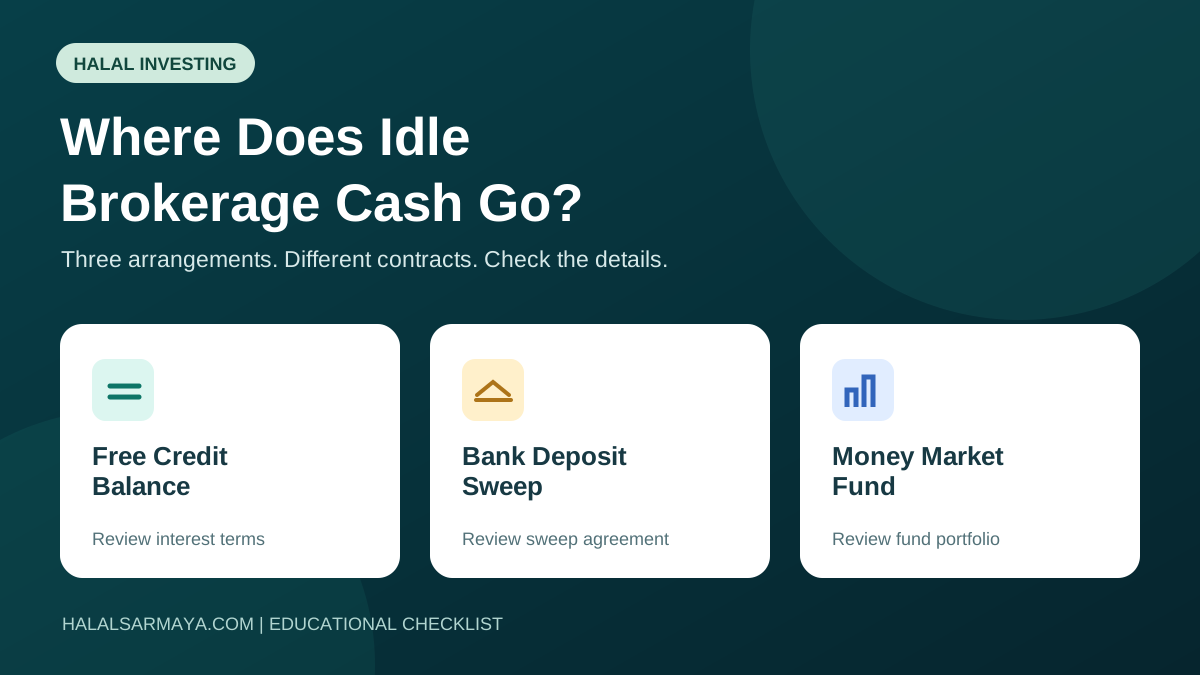
Three different things that brokers call ‘cash’
| Arrangement | Economic structure to verify | Documentation to inspect |
|---|---|---|
| Free credit balance | Uninvested money recorded as a broker liability; contractual terms may provide interest | Account agreement, interest schedule, monthly statement |
| Bank deposit sweep | Money transferred to program banks that may pay deposit interest | Sweep disclosure, bank list, rates, opt-out terms |
| Money-market fund core position | Fund shares acquired to hold short-term investments; portfolio assets may include debt securities and repurchase agreements | Fund name/ticker, prospectus, holdings and income statement |
These are not interchangeable. A fund is not automatically a bank deposit, and a settlement balance is not automatically an interest-free loan. The underlying agreement controls.
What published brokerage disclosures actually say
Fidelity’s core position
Fidelity explains that opening a brokerage account establishes a core position to process transactions and hold uninvested cash. Its disclosed alternatives include the Fidelity Government Money Market Fund (SPAXX), a taxable interest-bearing cash option (FCASH), and, for relevant accounts, an FDIC-insured deposit sweep. Fidelity describes SPAXX as investing primarily in cash, US government securities and related repurchase agreements. Its trading FAQ also describes how cash in the core position can earn interest. The availability of each choice varies by account, so verify what appears on your own statement rather than assuming all Fidelity customers hold SPAXX.
Charles Schwab’s cash features
Schwab’s October 2026 Cash Features Program disclosure describes a service that can automatically sweep an eligible brokerage account’s free credit balance into a liquid investment with the potential to earn interest. The program’s actual configuration, eligibility and rates matter. This is an example of why a trade confirmation alone is not sufficient: an investor may buy only screened shares, but idle cash can still be treated separately by the broker.
Important: these examples establish what the companies disclose. They do not establish that any particular account or option is Shariah-compliant or non-compliant without examining its terms under a chosen scholarly standard.
The Shariah issues to separate
Contract: is the arrangement an interest-bearing deposit, a brokerage credit balance, an investment in fund units, or another structure? Ask the provider for the current terms rather than inferring a contract from its marketing label.
Return: does the account explicitly promise or accrue interest? The State Bank of Pakistan’s Islamic banking FAQ describes interest on a loan or debt in the context of riba. That FAQ is a useful primary regulatory explanation of the conventional distinction, but it cannot adjudicate every international brokerage arrangement.
Invested assets: a conventional money-market fund generally requires a separate screening assessment of its actual portfolio and income. The word ‘government’ in a fund name is not a Shariah certification.
Incidental receipts: if the account has already credited interest, do not quietly relabel it as dividend income or ignore it. Seek qualified guidance about disposition, record keeping and applicable local law. Dividends from Shariah-screened shares require a different purification analysis, covered in our guide to reinvested dividend purification.
Brokerage cash sweep: an eight-step account checklist
- Find the exact legal entity and account type, including the country in which it is opened.
- Look for terms such as core position, cash sweep, cash management, free credit balance or money market on your statements.
- Write down any ticker or bank-program name shown beside the idle balance.
- Read the current account agreement and separate fund prospectus, if applicable.
- Confirm whether an annual percentage yield or interest credit is displayed and whether the arrangement is automatic.
- Ask support what happens when sale proceeds settle or a deposit reaches the account.
- Ask which alternative cash-holding choices are supported and what consequences a change would have for liquidity or settlement.
- Present the precise documents to a qualified adviser knowledgeable about Islamic finance; do not apply a universal label based on the broker’s brand.
Worked example: the balance changes, but the cash vehicle does not
Suppose an investor deposits a hypothetical $1,000, purchases $800 of shares and leaves $200 uninvested. A month later the investor sells $300 of shares, increasing the available settlement balance. The screen may show $500 in cash. The compliance question is not whether $500 is ‘small’; it is what contract or fund the $500 represents and whether it generates a return under the account’s terms. If a monthly statement contains a separately identified credit, ask the provider what generated it and which period it covers. These hypothetical amounts are for tracing the account mechanics only, not a tax or Shariah calculation.
Cash sweep records and common mistakes
- Keep dated copies of the account agreement, cash-sweep terms, fund prospectus and account statements.
- Record any account change, bank-program reassignment or fund ticker change, rather than assuming an old screenshot is still correct.
- Do not mix interest on idle cash with a company’s dividend purification rate: they arise from different sources.
- Do not equate insurance of an account’s deposit, or the existence of a regulator, with religious certification.
- Do not treat ‘zero commission’ as evidence of an interest-free cash arrangement; pricing of trades and treatment of idle cash are separate questions.
- If you hold an ETF as well, review the financial-ratio screening guide and the halal investing basics guide for the distinct issue of underlying holdings.
Frequently asked questions
Can I turn off a cash sweep?
Ask your broker whether your specific account permits a different cash arrangement, and request the applicable terms in writing. Before changing a cash sweep, establish where incoming deposits and sale proceeds would be held instead, whether that alternative pays interest, and whether the change affects settlement or liquidity. An opt-out is not itself proof of Shariah compliance; the replacement arrangement still needs review.
Is a cash sweep the same as purchasing a halal stock?
No. One concerns the account’s idle-balance arrangement; the other concerns the business and financial screening of the security you buy.
What if my account says ‘cash’ rather than ‘fund’?
Ask for the balance’s program name and agreement. Labels on dashboards are shorthand, not a substitute for legal and financial disclosures.
Can I infer Shariah compliance from a bank’s deposit guarantee?
No. Deposit protection and Shariah compliance address different questions.
Should I change my broker immediately?
Not on the basis of a generic article. Obtain current account documents and professional advice appropriate to your jurisdiction, goals and circumstances before making decisions.
Sources and verification
- Fidelity — What is a core position? (account-specific choices and money-market disclosure).
- Fidelity — Trading FAQ: About your account (cash processing and interest).
- Charles Schwab — Cash Features Program Disclosure Statement, October 2026.
- State Bank of Pakistan — Islamic banking FAQs (riba and interest definitions).
Editorial review: October 23, 2026. This page provides general educational information only. Products, countries, broker policies and scholarly views differ; always verify original documentation and obtain qualified advice. Written for HalalSarmaya, author attribution: Dr. Zahid Al Hakim.