
Do you need thousands of dollars to start halal investing?
Not necessarily.
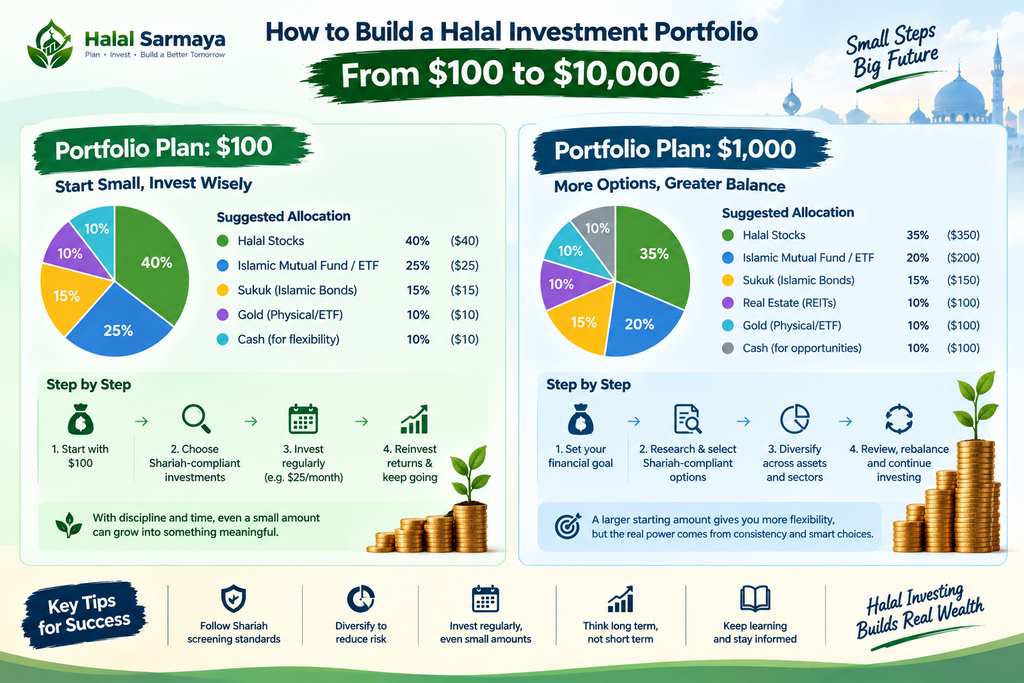
Many people believe investing is only for those who already have a large amount of money. In reality, you can begin building a halal investment portfolio with a relatively small amount and gradually increase your investment over time.
Starting with $100 will not automatically turn into $10,000. Reaching that goal depends on several factors, including how much you invest, how consistently you invest, investment performance, time, and your ability to manage risk.
The goal is not to get rich quickly. The goal is to build wealth gradually, responsibly, and in accordance with Shariah principles.
In this guide, we’ll explore how you can start with $100, understand halal investments, diversify your portfolio, invest consistently, and work toward a long-term $10,000 goal.
Can You Start Halal Investing With $100?
Yes, depending on the investment platform, available investment products, and minimum investment requirements.
The amount you start with is less important than developing good investing habits.
For example, you could:
Start with $100 → Invest regularly → Choose Shariah-compliant investments → Diversify → Reinvest returns → Stay invested for the long term
This approach focuses on building a sustainable investing habit rather than trying to make a large profit quickly.
However, remember that $100 is only a starting point, not a guarantee of reaching $10,000.
1. Define Your Investment Goal
Before choosing an investment, ask yourself:
Why am I investing?
Your goal could be:
- Building long-term wealth
- Saving for retirement
- Preparing for future expenses
- Building financial independence
- Creating a long-term investment portfolio
Your investment goal can influence how much risk you are willing to take and how long you plan to stay invested.
A long-term investor may have a different strategy from someone who needs their money in the next 1–2 years.
2. Understand What Makes an Investment Halal
One of the most important parts of halal investing is understanding what you are actually investing in.
A company may appear attractive because its stock price is rising, but that does not automatically mean it is Shariah-compliant.
Investors should consider factors such as:
- The company’s primary business activity
- Its sources of revenue
- Its level of interest-based debt
- Its interest-bearing assets
- Relevant financial ratios
- Applicable Shariah screening standards
Businesses involved in activities prohibited under Islamic principles may be excluded from Shariah-compliant investment portfolios.
Examples can include certain businesses associated with:
- Gambling
- Alcohol
- Pork-related products
- Conventional interest-based financial services
- Other prohibited activities
However, Shariah screening can involve more than simply checking what a company sells. Financial criteria and screening methodologies can also play an important role.
3. Choose Shariah-Compliant Investments
Once you understand the basic principles, the next step is finding investments that meet an appropriate Shariah screening methodology.
Depending on your country and available investment platforms, options may include:
- Shariah-compliant stocks
- Islamic mutual funds
- Shariah-compliant ETFs
- Sukuk
- Gold
- Real estate
- Other permissible investment opportunities
Different scholars, institutions, and screening methodologies may sometimes produce different results.
Therefore, investors should understand which Shariah standard or screening methodology is being used rather than assuming that every halal investing platform uses exactly the same criteria.
4. Don’t Put Everything Into One Investment
Imagine you have $1,000 and put the entire amount into a single company.
If that company experiences serious problems, a large portion of your portfolio could be affected.
This is why diversification can be an important part of a long-term halal investment strategy.
Instead of relying on one company or one sector, investors can consider spreading their investments across different suitable assets and sectors.
Diversification does not eliminate risk, but it can help reduce dependence on a single investment.
The objective should not be to own everything.
The objective should be to build a portfolio that matches your:
Goals + Risk Tolerance + Time Horizon + Shariah Requirements
5. Invest Consistently
Starting with $100 is one thing.
Continuing to invest is what can make the bigger difference over time.
For example, imagine you start with:
Initial investment: $100
Then you invest:
$100 every month
That would mean adding approximately:
$1,200 per year
to your portfolio, before considering investment returns.
This illustrates an important principle:
Your long-term wealth is influenced not only by investment returns, but also by how much you consistently contribute.
If your income increases over time, you may also be able to increase your monthly investment.
6. Understand the Power of Compounding
Compounding is one of the most important concepts in long-term investing.
In simple terms, when investment returns remain invested, those returns can potentially contribute to future growth.
For example:
Your investment → Potential return → Reinvest → Larger investment base → Potential future growth
Over long periods, this process can become increasingly significant.
However, compounding does not mean guaranteed profits.
Investments can lose value, and actual returns can vary significantly from year to year.
7. How Long Does It Take to Grow $100 Into $10,000?
There is no single answer.
The time required depends on several factors:
- Your initial investment
- Monthly contributions
- Investment returns
- Investment fees
- Market conditions
- How long you remain invested
- Whether returns are reinvested
For example, someone who invests only $100 once and never contributes again will have a very different outcome from someone who starts with $100 and invests another $100 every month.
This is why reaching a $10,000 portfolio is not simply about finding an investment that produces a high return.
It is also about time and consistency.
8. Example: Building Toward a $10,000 Portfolio
Consider a hypothetical investor who starts with:
$100 initial investment
and then contributes:
$100 per month
After 1 year, the investor would have contributed:
$1,300
This includes the initial $100 plus 12 monthly contributions of $100.
After several years, continued contributions could bring the total amount invested much closer to the $10,000 target.
Any investment returns could increase or decrease the portfolio’s value, depending on market performance.
This is why a $10,000 goal should be viewed as a long-term financial target rather than a guaranteed outcome.
9. Avoid Chasing Quick Profits
One of the biggest mistakes new investors can make is focusing entirely on short-term returns.
You may see an investment increase rapidly and feel tempted to invest because everyone else appears to be making money.
But high potential returns often come with higher risks.
A better approach is to ask:
Do I understand this investment?
Is it Shariah-compliant according to a credible screening methodology?
What are the risks?
Does it fit my investment goals?
Can I handle a significant decline in value?
These questions can help you make more thoughtful investment decisions.
10. Common Mistakes in Halal Investing
Mistake 1: Choosing a Stock Only Because Its Price Is Rising
A rising stock price does not automatically make an investment suitable.
Always research the underlying company and its financial position.
Mistake 2: Ignoring Shariah Screening
A company’s products may appear permissible, but its financial structure may still require further screening.
Mistake 3: Putting Too Much Money Into One Stock
Concentration can increase portfolio risk.
Mistake 4: Trying to Get Rich Quickly
There is no reliable shortcut to building long-term wealth.
Mistake 5: Making Emotional Decisions
Markets rise and fall.
Selling in panic or buying because of excitement can lead to poor decisions.
Mistake 6: Never Reviewing Your Portfolio
A company’s business activities and financial ratios can change.
Therefore, Shariah compliance should not necessarily be treated as a permanent label without periodic review.
11. What Happens When Your Portfolio Reaches $1,000?
Reaching your first $1,000 can be an important milestone.
At this stage, you may have more flexibility to think about:
- Portfolio diversification
- Different sectors
- Investment allocation
- Risk management
- Long-term goals
- Regular contributions
- Shariah screening
The objective should be to improve the quality of your investment process rather than simply chasing a higher return.
12. Moving From $1,000 Toward $10,000
As your portfolio grows, your strategy may need to become more structured.
You can consider:
Reviewing your portfolio → Checking diversification → Reviewing Shariah compliance → Continuing regular contributions → Rebalancing when appropriate
The exact approach will depend on your personal circumstances and investment strategy.
There is no universal portfolio allocation that is suitable for everyone.
Is a $10,000 Halal Investment Portfolio Realistic?
It can be a realistic long-term goal, but it should never be treated as a guaranteed result.
The path from $100 to $10,000 could take different amounts of time for different investors.
Someone who contributes more each month may reach the target sooner.
Someone who contributes less may take longer.
Investment performance can also have a major impact.
The most important lesson is this:
You don’t need to start big. You need to start responsibly and remain consistent.
The Bigger Goal: Building Wealth the Halal Way
Halal investing is not simply about finding investments that can potentially generate high returns.
It is also about making financial decisions that align with Islamic principles.
A thoughtful halal investor should consider:
Is the investment permissible?
What risks am I taking?
Do I understand the investment?
Does it fit my long-term goals?
Am I investing consistently and responsibly?
When these questions become part of your investment process, you can begin building a more disciplined approach to wealth creation.
Final Thoughts
You do not need $10,000 to start building a halal investment portfolio.
You can begin with a smaller amount, such as $100, and gradually build your portfolio through regular contributions, appropriate diversification, careful research, and long-term discipline.
But remember:
$100 does not automatically become $10,000.
There are no guaranteed investment returns, and every investment involves risk.
Your journey will depend on how much you contribute, how your investments perform, how long you remain invested, and how effectively you manage risk.
The goal should not be to get rich overnight.
The goal is to build wealth responsibly, invest according to Shariah principles, and develop strong financial habits for the long term.
Frequently Asked Questions
Can I start halal investing with $100?
Yes, depending on the investment platform and available Shariah-compliant investment options. However, minimum investment requirements and available products vary.
How can I build a halal investment portfolio?
Start by defining your financial goals, learning about Shariah-compliant investing, screening potential investments, diversifying appropriately, and contributing consistently over the long term.
Can $100 become $10,000 through investing?
It is possible for a portfolio to grow significantly over time, but there is no guarantee that $100 will become $10,000. Regular contributions and investment performance can have a major impact.
What are examples of halal investments?
Depending on the relevant Shariah standards and screening criteria, examples may include Shariah-compliant stocks, Islamic funds, Shariah-compliant ETFs, Sukuk, gold, and certain real estate investments.
Is halal investing risk-free?
No. Halal investing is not risk-free. Shariah compliance does not guarantee profits or protect an investor from market losses.
Important Disclaimer
This article is for educational and informational purposes only. It is not financial, investment, tax, or religious advice and should not be considered a personal recommendation or fatwa. Investment values can rise or fall, and past performance does not guarantee future results. Shariah screening methodologies can differ, and investors should conduct their own research and consult qualified financial and Shariah advisers when appropriate.
Suggested WordPress Tags
Halal Investing, Halal Investment, Islamic Finance, Shariah Compliant Investing, Halal Stocks, Islamic Investing, Wealth Building, Personal Finance, Halal Wealth, Investment Portfolio
Suggested Featured Image Text
FROM $100 TO $10,000
Build Your Halal Investment Portfolio
Invest • Grow • Stay Shariah-Compliant